Welcome to Lucent University, a non-profit evangelical institution in the heart of Texas, USA. Our university is driven by a mission to make ministry training accessible and affordable to individuals across the globe. We are dedicated to equipping our students with the knowledge and skills necessary for powerful and effective ministries, fostering a community of learners who are ready to make a positive impact in the world.
About Us
Lucent University is an evangelical multi-denominational institution that aligns with the historical teachings of various Christian denominations such as Baptists, Methodists, Presbyterians, Lutherans, Assemblies of God, and independent Bible Churches.
We are committed to offering our programs online at prices that are affordable worldwide. The cost of our programs is determined for each country using the World Bank's Purchasing Power Parity (PPP), ensuring that education is accessible to all.
The Ministry Path
At Lucent University, our programs are crafted with a deep understanding of the spiritual and practical challenges faced by Gospel Ministers in today's world. Our degrees are designed to be practical, equipping you with the necessary skills to effectively engage in various ministerial roles.
Our curriculum is developed by esteemed professors who have earned advanced degrees from renowned institutions such as Southwestern Baptist Theological Seminary, Dallas Theological Seminary, Dallas Baptist University, and Gateway Seminary.
We prepare our students for a range of ministry positions including Pastors, Youth Ministers, Discipleship Directors, Educators, Organizational Administrators, Evangelists, Missionaries, and Church Staff. Our alumni are actively engaged in meaningful work across the globe, serving in churches, communities, educational institutions, and mission fields.
Our Programs
Flexible, affordable online programs
Lucent University's programs are designed for those who seek the flexibility and affordability of online education without sacrificing quality.
Our self-paced video classes allow you to study from any location, at any time, so you can fit your education into your own schedule.
Our advanced Learning Management System (LMS) delivers a seamless educational experience, with high-quality content produced by esteemed professors. It works on any device, so you can learn on the go or from the comfort of your home.
Undergraduate
Associate Degree
2 years · four 6-month terms 20 courses · 60 credit hours
The Associate Degree in Ministry is tailored for individuals looking to pursue ministry after completing High School or its equivalent. The program builds a thorough understanding of spiritual practices and core ministry skills such as expository preaching, biblical counseling, apologetics, servant leadership, and organizational management, equipping students with the tools they need for effective ministry and educational roles within their communities.
Admission requires a High School diploma or equivalent and an intermediate level of English proficiency; no prior ministry experience is required. Graduates are prepared to serve as Pastors, Associate Pastors, Worship Leaders, Youth Pastors, Missionaries, Chaplains, Church Planters, and Christian Educators.
The Bachelor of Applied Theology and Ministry is designed to thoroughly prepare you for impactful ministry work. It begins with the doctrinal and interpretive foundations of the faith (Scripture, systematic theology, hermeneutics, and apologetics), then moves through a full survey of the Old and New Testaments, including the life of Christ and Old Testament wisdom literature.
From there, it builds core ministry skills in expository preaching, worship, servant leadership, and pastoral care, with practical strategies for evangelism, missions, and small-group discipleship. The final terms sharpen your ability to work with the Bible in its original Greek and Hebrew, address contemporary pastoral challenges such as addiction, family dynamics, and mental health, and apply technology to 21st-century ministry.
Each course culminates in an applied project connected to real ministry practice, and graduates complete a portfolio of five-year ministry plans across multiple areas of service. You will be equipped to serve as a pastor, church leader, missionary, chaplain, or educator. The requirement for enrollment is a High School diploma or an equivalent Secondary School certificate.
Graduate
Master's Degrees
Lucent University offers a suite of Master's degree programs for people who have a Bachelor's degree in any field. Each program is designed for ministry-minded professionals who want to deepen their biblical knowledge and strengthen their ministry skills. Graduates gain the skills to evangelize, lead, teach, provide spiritual support, and offer counsel to those in need.
The Master of Divinity (MDiv) is Lucent's full pastoral-vocation degree, combining theological depth with ministry practice. It covers biblical languages, hermeneutics, pastoral leadership, expository preaching, and contemporary ministry challenges. Admission requires a Bachelor's degree and an advanced level of English proficiency. Graduates pursue roles such as pastors, missionaries, chaplains, counselors, and church administrators.
Designed for Bible teachers, future seminary faculty, and pastors who want theological depth. It emphasizes primary-source scholarship: exegesis in the original languages, systematic theology, hermeneutics, church history, and apologetics, with a defended graduate research paper in each course. Admission requires a Bachelor's degree, with intermediate proficiency needed for the Hebrew and Greek components. The M.Th. is complementary to the M.M.: the same student can stack both programs into a Master of Divinity (MDiv)-equivalent path.
Designed for senior pastors, ministry directors, and lay leaders who want graduate-level practical ministry credentials. Each course produces a defended, research-grounded five-year plan, and graduates complete a full strategic portfolio for their own church or organization, defended before faculty. Admission requires a Bachelor's degree. The M.M. is complementary to the M.Th.: the same student can stack both programs into a Master of Divinity (MDiv)-equivalent path.
Coming soon
Doctor of Ministry (D.Min.)
24 to 36 months 12 courses · 36 credit hours
Lucent University is preparing to launch a Doctor of Ministry (D.Min.) in Applied Artificial Intelligence in Ministry, a professional doctorate for experienced pastors, denominational leaders, and missionaries who want to lead confidently at the intersection of ministry and emerging technology. The program combines a Core Foundation and an Applied Ministry Project. It is not yet open for enrollment; details will be announced as the launch date approaches.
Certificates
Certificate Programs
About 6 months 4 courses · 12 credit hours
Focused programs for those who want to deepen their expertise in a specific area of ministry without committing to a full degree. No prerequisites are required.
Certificate in Preaching “Preach the Word”
Built on Lucent's most highly rated homiletics courses, for senior and associate pastors, lay preachers, teaching elders, Bible-college faculty, and missionaries who preach regularly.
Certificate in New Testament “Master the New Testament”
For Bible teachers, seminarians, lay students with a focused interest in the New Testament, and missionaries serving in apostolic-frontier contexts.
Certificate in Apologetics “Defend the Faith”
For pastors, campus ministers, lay defenders of the faith, and Christian educators serving in secular or pluralistic contexts.
Open to everyone
Independent Courses
About 180 days No prerequisites
Lucent University's Extension Courses offer a flexible way to grow in a specific area of ministry without the commitment of a full degree program. These self-paced courses are open to anyone, regardless of age, previous education, or English proficiency.
Hebrew Old Testament Tools and Exegesis
Interpret the Hebrew Old Testament without years of traditional language study: the Hebrew alphabet, grammar, lexical tools, textual criticism, genre interpretation, and practical ministry application. No prerequisites are required.
Greek New Testament Course
Interpret the Greek New Testament without extensive language study: grammar, lexical tools, textual criticism, and exegesis for sermon preparation. No prerequisites beyond basic English proficiency are required.
Billy Graham School of Evangelism
Delivered by Lucent University under a contractual agreement with the Billy Graham Evangelistic Association, this course equips you to share the Gospel with clarity and conviction. It is organized into four sequential courses (Preparation, Proclamation, Power, and Preservation) and awards a digital certificate upon completion of each.
Frequently Asked Questions
Your questions, answered
Everything about enrollment, tuition, your courses, and graduation, organized in thirteen topics.
1
Enrollment
How do I access my program?
To access your program, enroll online by filling out the enrollment form. You can choose between Degree and Certificate programs or Extension courses, depending on your goals and interests. After you submit the form, you will see a new page where you confirm your login and password. Then you will have access to your dashboard, where you make payments and upload documents.
How is the program offered?
Lucent University delivers your program through an advanced, easy-to-use online Learning Management System (LMS). You can find everything you need on a single page: watch your lessons, view your materials, and take your exams. You can also submit your work, pay your fees, and reach out to your instructors. The learning platform works on any device, so you can learn wherever and whenever you want, with the same great interface on a smartphone or a big-screen TV.
What documents are required for enrollment?
You need to upload two government-issued IDs, one of them with your photo. You can use bills, bank statements, or other official papers as proof of residency. If you're taking continuing education courses, that's all you need.
Associate or Bachelor's degree: also upload your high school diploma and transcripts.
Master's degree: also upload your Bachelor's degree diploma and transcripts.
You have 90 days from the day you enroll to upload everything. Make sure the images are clear and high quality. If your documents are in non-Roman characters, you need to translate them into English.
Can I start at any time?
Yes, you can start your courses and advance in your program whenever you want. The first step is to enroll and choose a degree program. If you need help deciding which program is best for you, please contact Lucent. After enrolling, you will need to confirm your login address and complete the enrollment process, including setting up a payment plan, uploading the appropriate documents, and taking the Test of English Comprehension (TEC) if required.
How do I upload my documents?
Go to your learning dashboard and click on your profile picture. Then select the Documents tab and choose the files you want to upload. You can also reach the Documents section by clicking on your name in the top-right corner and going to My Profile.
What is self-paced learning?
Self-paced learning lets you study at your own pace without regular classes or interactions. Lucent offers self-paced degree programs that are flexible, affordable, and Bible-based. You can study online and ask questions through your dashboard if needed. It is a great fit for distance learners who want more flexibility and control over their learning.
2
Tuition and Fees
What is the cost of the program?
The price of the program depends on where you live. Lucent University uses the World Bank's Purchasing Power Parity (PPP) to set the price. To see your monthly tuition, go to the program page and choose your country from the dropdown menu in the “Affordable” section.
We cannot consider your nationality for tuition: our institutional policy requires program tuition to be based on the applicant's country of residence in order to apply the PPP calculations.
You can pay with any major debit or credit card or with PayPal. Card payments are processed by Stripe. If you don't have a PayPal account, you can create one on the PayPal website for your country.
If you miss a payment, you won't be able to access the learning dashboard until you pay. As soon as you pay, your access is restored.
Are books and materials included in the program?
Yes. Books and materials are included: you can download everything you need for your studies from the learning dashboard for free.
Do all programs cost the same?
No, prices vary by program and by country. To find out your monthly tuition, visit the program page and select your country of residence from the dropdown menu.
How can I apply for a scholarship?
Students who need financial assistance may be eligible for special scholarships. To apply, please fill out the scholarship application. The decision on financial aid will be communicated within a week of submission.
3
Programs
What degrees are offered?
We offer degrees for different educational and ministry needs:
Associate degree: a two-year program that gives you the essential knowledge and skills for ministry. You can choose the Associate of Ministry or the Associate of Theology; both have 60 credit hours of courses. The Associate degree is an abbreviated version of the Bachelor's and is considered a higher education degree in the US.
Bachelor's degree: a 36-month (three-year) comprehensive program that trains you for a powerful and meaningful ministry, with 90 credit hours of courses.
Master's degree: deepens your understanding of the Bible and equips you for advanced ministry or teaching. Choose the Master of Ministry or the Master of Theology (18-month programs with 36 credit hours), or the Master of Divinity (MDiv) (a three-year program with 72 credit hours).
What are credit hours?
A credit hour measures how much time you spend on a course, including lecture time, exams, reading, and the other assignments that help you learn.
What are independent courses?
Independent courses at Lucent University are self-paced, specialized programs designed for focused study. They are 180-day programs with no prerequisites, and they require a one-time tuition payment rather than a monthly plan.
4
Languages
Do I have to be fluent in English?
English proficiency is a prerequisite for all programs at Lucent, except for continuing education courses. If you are not a native English speaker, you will take the Test of English Comprehension (TEC), a free online exam that measures your ability to understand written and spoken English.
Associate or Bachelor's degree: intermediate level of English.
Master's degree: advanced level of English.
The TEC has 100 multiple-choice questions covering vocabulary, grammar, reading, and listening. You have 90 minutes to complete it, and you need at least 70 points out of 100 to pass. If you don't reach this score on your first attempt, you can retake the exam up to 3 times at no extra cost.
5
Learning Pace
How long does it take to complete a program?
You can complete a term faster or slower than the recommended six-month period, depending on your pace. The six-month period is a general guideline for finishing your required courses. Since the program is self-paced, you can finish your coursework before or after the six months, and you can request more time if you need it. The shortest time for a term is four months, and the longest is eight months.
If you want to move on to the next term sooner, you can apply for advancement once you have completed all the course requirements for the current term. You do this through your learning dashboard, and you pay the remaining tuition for the current term and the first installment of the following term before moving on. Approval may take up to 14 days and depends on the availability of courses for the next term.
There are two ways to finish a program early: advancing each term (minimum four months per term, subject to course availability) or transferring credits from another program.
Likewise, you can ask for an extension of up to two months by submitting an extension request through your learning dashboard. There is no extra cost for extension requests. Approval may take up to 14 days.
How much time do I need to dedicate to my studies?
Because our programs are fully online and entirely self-paced, we do not monitor or require a fixed number of daily study hours. As a general guideline:
Independent courses: about 3 h/week Associate or Bachelor's: about 8 h/week Master's: about 12 h/week
Can I change my program after enrollment?
To change your program after enrolling, submit a written request to Lucent's academic office. Students in the Master of Ministry, Master of Theology, or Master of Divinity (MDiv) may request to switch among these three programs, depending on the availability of the program they want to join. Each request is reviewed individually, and additional fees may apply. Please note that courses completed in a bachelor's program cannot be transferred or applied toward a master's program.
6
Credit Transfer
Can I transfer credits from another institution?
Yes. Send us an official transcript from the other institution, and we will check whether the courses you took are similar to ours based on their learning outcomes. We decide whether we can accept your credits depending on the program you want to join and the program you have finished or started. We can accept at most three credit hours per course.
The maximum number of credits we can accept in total is 75% of the program requirements, as per the Distance Education Accrediting Commission (DEAC) standards.
The Distance Education Accrediting Commission (DEAC) is an organization that evaluates and accredits distance education institutions and programs. DEAC is recognized by the U.S. Department of Education and the Council for Higher Education Accreditation as a reliable authority on quality and integrity in distance education. DEAC accredits institutions and programs from the primary level through universities, covering all distance education activities within them.
What institutions accept degrees or credits from Lucent University?
Lucent University cannot guarantee that other colleges or universities will accept your degree and/or credits from Lucent. If you want to continue your education at another institution after studying at Lucent, contact that institution and ask whether it will recognize your Lucent degree and/or credits before you enroll.
7
Support
Academic Support
Our team of academic advisors can help you with questions about registration, pricing, program duration, and course content. Contact academic support through the learning dashboard or the contact form. We respond within 1 business day.
Technical Support
Our technical team can help with any issue related to the learning system, such as logging in, accessing materials, submitting assignments, or taking exams. Contact technical support through the learning dashboard or the contact form. We resolve problems within 2 business days.
8
Assignments
Assignments are the written work you complete in each course. They are guided steps that help you take what you learn and use it in real life and real ministry. Every degree course follows the same clear structure, so once you understand how one course works, you understand them all.
How every course is organized
Each degree course is built from the same core parts, so you always know what to expect. Every course gives you:
Syllabus. A short guide that explains the course, the units, and the work you will do.
Reading Material. Selected readings, provided for you inside the LMS (your online learning platform).
Media Resources. Videos and other media that support your learning, listed in the LMS.
Three Exams. Multiple-choice exams that check your understanding as you move through the course.
Five Assignments. The written work described in this chapter, including the Growth Assessment.
Feedback. Lucent University regularly invites students to provide feedback on their courses and learning experience. Course evaluations help the University assess the quality of instruction, course materials, and academic support, and identify opportunities for continuous improvement. Student feedback is an important part of Lucent’s commitment to academic quality and program development.
Most courses are divided into 18 units, or 6 modules with 3 units each. You move through them one at a time, at your own pace.
The three kinds of courses
Lucent courses share the same structure, but the assignments are shaped to fit the goal of the course:
Foundational courses. These build your knowledge of the Bible, theology, and Christian thinking. Their assignments help you understand ideas deeply and connect them to Scripture.
Ministry courses. These prepare you for practical service, such as preaching, evangelism, or pastoral care. Their assignments help you turn ideas into a real plan of action.
Hybrid (blended) courses. These mix both goals. Their assignments are chosen to match the course, so they may include some work from each of the other two kinds.
Your syllabus always tells you which kind of course you are taking and which assignments you will complete.
Your five assignments
Every degree course has five assignments. Together they move you along a clear path: from reading and understanding, to comparing and applying, to practicing and planning. The first four are graded and count toward your course grade. The fifth is the Growth Assessment, explained below.
In a Foundational course
Reading Connection Analysis. Read a key text and connect its main ideas to the course and to Scripture.
Comparative Application. Compare different ideas or viewpoints and apply them to a real question.
Practice Paper. Practice an important skill from the course in a short, focused piece of writing.
Integrative Project (Capstone). A larger final project that brings the whole course together into one complete piece of work.
Growth Assessment. A personal, spiritual reflection.
In a Ministry course
Reading Application. Read a key text and apply its lessons directly to ministry.
Strategic Application. Build a clear strategy to meet a real ministry need.
Action Lab. Carry out one real act of ministry and then reflect on what happened.
Five-Year Ministry Roadmap (Capstone). Design a long-term plan for your own ministry.
Growth Assessment. A personal, spiritual reflection.
In a Hybrid course, the assignments are selected from both lists to fit the subject. Your syllabus names the exact assignments for that course.
The Growth Assessment
The Growth Assessment is a personal, spiritual reflection. It is required to complete the course, but it is graded only on completion and does not count toward your course grade. Simply complete it honestly and thoughtfully.
Where do the readings for my assignments come from?
The books and readings used in your assignments are in the public domain, so you will find a copy of each one already provided for you inside the VisEd LMS, ready to read.
You are also welcome to look for these books on your own. Because they are in the public domain, different versions are freely available online, sometimes in different formats (PDF, e-book, audiobook, and others) and from different sources. You may use the version in the LMS or any other free version you find, as long as it is the same book and edition indicated in your assignment.
What are the passing grades?
Exams are multiple-choice, and assignments are scored from 1 to 100 points. To pass, you need at least 60 points (a D letter grade) in the Associate, Bachelor's, and Certificate programs, and at least 70 points (a C letter grade) in the Master's programs. You can retake an exam as many times as you need until you pass, and each exam gives you different questions each time.
Your grade for a course is the weighted average of the grades you earn on the exams and assignments in that course. Your syllabus shows how much each part is worth. The point totals correspond to the following letter grades:
Letter Grade
Percentage Range
GPA
A+
97–100%
4.00
A
94–96%
4.00
A-
90–93%
3.70
B+
87–89%
3.30
B
83–86%
3.00
B-
80–82%
2.70
C+
77–79%
2.30
C
73–76%
2.00
C-
70–72%
1.70
D+
67–69%
1.30
D
65–66%
1.00
F
0–64%
0.00
Do I have to write a thesis?
No. You do not have to write a traditional thesis, book review, or long research paper in the older sense. Your written work is done through the five assignments above, which guide you step by step and help you connect the course material to your own ministry context.
Lucent courses are self-paced, so there are no fixed due dates for your assignments. You are free to move through the course as your schedule allows. We still encourage a steady pace, and many students complete about one unit each week, but the timing is up to you.
How do I turn in my work?
When you finish an assignment, save it as a PDF and upload it in the matching assignment area on the LMS. After your work is reviewed, you will receive feedback to help you understand your strengths and grow in the areas that need more attention. If you have any trouble submitting your work, our technical support team is ready to help.
What if a safety issue or other serious circumstance keeps me from completing an assignment?
If a safety concern, or any other serious circumstance, keeps you from completing one or more of your assignments as originally designed, please contact our team. We will evaluate your situation and offer a proposal suited to your specific context.
You must never lie about your situation or submit a false or fabricated report to get around an assignment. Complete honesty is essential, both for your own growth and for the integrity of your work.
Whenever you face any difficulty completing your coursework, please contact our support team. We will guide you on exactly how to proceed.
9
Cancellation
Can I pause my studies?
You can pause your studies anytime you need to and resume when you are ready. You do not pay any monthly tuition during the pause. To pause or resume your program, email us from the contact area of your learning dashboard or use the contact form on our homepage. Please note that the current tuition on the program page will apply when you return, and you may lose your scholarship if you pause your studies for more than six months.
Can I withdraw from a program?
Yes, you can withdraw through the learning dashboard or the contact page. It may take up to 30 days for us to process your withdrawal. You don't pay any fine or fee if you don't owe us any money, but we don't give a partial refund if you have already paid the tuition for the month in which you asked to withdraw.
What is the refund policy?
If you pay monthly and want to withdraw or cancel, you won't get any money back for the month in which you do it. However, you can still use the class material for the rest of that month, and we won't charge you for any future months.
If you have paid for multiple months or the whole program in advance and want to withdraw, we will refund 80% of the money left for the remaining months. We send the refund within 30 days of receiving your notice of withdrawal or cancellation, to the same payment method you used.
You are considered withdrawn if you tell us you want to withdraw, or if we end your enrollment because you don't attend, don't make enough progress, don't follow the rules, or don't pay what you owe.
10
Graduation
What happens when I finish my program?
When you complete your program, the digital PDF copy of your Diploma or Degree will be available for download in your learning dashboard.
Printed Degree: we can ship your printed degree via UPS to your home or church address within 90 days. You cover the shipping cost. The processing and handling fee is US$ 50.00 per copy, in addition to shipping. All degrees are printed on standard US Letter size (8.5 x 11 inches). Once shipped, the carrier is responsible for delivering the package; we share tracking information but can't guarantee or assume liability for delays, loss, or damage in transit. Lucent University does not sell or ship graduation caps and stoles; you will need to purchase these locally or online.
Digital Degree: we email you a high-resolution PDF of your degree. The file includes a Digital Certificate Number (DCN) verifiable on CertVue. You can print the PDF on any paper type, size, or color, and even frame it. We usually recommend this option because it is faster and more practical. Buying your graduation cap and stole locally is a cost-effective option.
After graduation, you can still use your dashboard to access the video classes, reading materials, and all other resources available to current students.
Requirements to receive your Diploma or Degree
Upload all the required documents to your student profile accurately.
Pay all your tuition and fees in full, with no outstanding debt.
Finish all your coursework, including required class time, reading materials, exams, and assignments, and pass all your courses.
Maintain a minimum overall grade point average corresponding to at least 60% in the Associate, Bachelor's, and Certificate programs, or at least 70% in the Master's programs.
Graduation Ceremony
Completing a degree program is a significant milestone and an accomplishment worth celebrating. It marks the end of an important season of learning, dedication, and spiritual growth.
If you would like to celebrate with family, friends, and your church community, you are welcome to organize a graduation ceremony at your local church. It can be a meaningful way to recognize your achievement, give thanks to God, and share this moment with the people who supported you throughout your studies.
How will my academic records be kept?
While you are enrolled, you can access your academic records digitally through your student dashboard. After graduation, Lucent will continue to keep a digital copy of your records with a secure, established global cloud storage provider.
How can I request a transcript?
The optional PDF version of your official transcript is available for a one-time fee of US$50.00. The same one-time fee applies if you require a partial transcript for an employer or transfer application before completing your full degree. To request an official transcript or a copy of your academic records, please contact Lucent.
11
Authorization and Accreditation
What is authorization and accreditation?
Authorization refers to the legal authority of an institution to offer educational programs in a particular jurisdiction. Depending on the state, this may involve obtaining authorization or a license to operate, qualifying for an exemption, or operating in a state where specific authorization is not required.
Accreditation is a quality assurance process conducted by an independent accrediting organization. Accrediting bodies evaluate areas such as academic standards, institutional policies, governance, student services, and operational practices according to their established criteria.
Authorization and accreditation serve different purposes. Authorization relates primarily to an institution's legal permission to operate, while accreditation evaluates institutional quality according to the standards of the accrediting organization.
What authorization does Lucent University have?
Lucent University operates in Texas under a religious instruction exemption from the Texas Higher Education Coordinating Board (THECB).
For students residing outside Texas, Lucent University enrolls students only in states where the University has obtained the required authorization, qualifies for an applicable exemption, or where state regulations do not require additional authorization for its educational activities.
Because authorization requirements vary by state, prospective students should verify that Lucent University is authorized or otherwise permitted to enroll students in their state of residence before enrolling.
What organization accredits Lucent University?
Lucent University holds Premier Institution accreditation from the Accreditation Service for International Schools, Colleges, and Universities (ASIC), an international accrediting organization based in the United Kingdom.
Lucent University also holds UK Recognized (UKVI) status and ISO 9001:2015 certification and participates in international organizations and networks related to education, quality assurance, and academic mobility, including BQF, ENQA, EDEN, and NAFSA.
Lucent University is not currently accredited by a U.S. regional or national institutional accrediting agency recognized for that purpose in the United States. Students who require a degree from a U.S.-accredited institution for employment, professional licensure, further education, transfer of credits, immigration purposes, or other specific requirements should carefully verify whether a Lucent University degree will meet those requirements before enrolling.
Lucent University is currently pursuing U.S. accreditation.
12
Code of Conduct and Privacy Policy
Code of Conduct
The Code of Conduct is the set of rules and expectations Lucent University has for its students. It covers both personal and academic conduct and aims to foster a Christian educational community that honors God and respects others. It explains what is considered dishonest or unacceptable behavior and the possible consequences if a student violates the code. It also encourages students to uphold the moral and ethical standards of Lucent University and to report any major violations to university personnel. The Code of Conduct is not a contract and can be revised at any time by the university. Students are responsible for knowing and complying with it.
Privacy Policy
The Privacy Policy explains how Lucent University handles your personal data and respects your privacy rights. It tells you what data we collect, what we do with it, and who we share it with. It also explains how you can access, update, or delete your information, except for your academic records, which cannot be deleted. We follow the European Union General Data Protection Regulation (GDPR), a law that protects your privacy and data security. Our Privacy Policy applies to all our services and activities, such as courses, programs, events, and websites.
13
Disability
What if I have a disability?
Lucent University is committed to providing equal access and opportunity to students with disabilities. We offer resources and accommodations in our Learning Management System to help students with visual and auditory disabilities learn effectively and comfortably. We comply with the federal laws that prohibit discrimination based on disability and ensure that our academic requirements are fair and reasonable. These laws include Section 504 of the federal Rehabilitation Act of 1973; the Americans with Disabilities Act of 1990, Title II; and their implementing regulations at 34 C.F.R. Part 104 and 28 C.F.R. Part 35.
If you have a disability and need any special assistance or consideration, please let us know by contacting our support team after you register. We will do our best to meet your needs and help you succeed in your ministry education.
Admissions and Enrollment
How admission and enrollment work
Procedures Overview
Lucent University operates exclusively online, and all procedures begin on the main website. Since sponsored tuition is available, a sponsor can contact us with the names of the students who will receive it.
Lucent University keeps computerized records for all its students. This information is collected from the data students provide through the application and enrollment processes and through their course and module registrations. It is covered by the relevant Data Protection legislation, and students have the right to access this data at any time through Lucent University administration.
The Admission
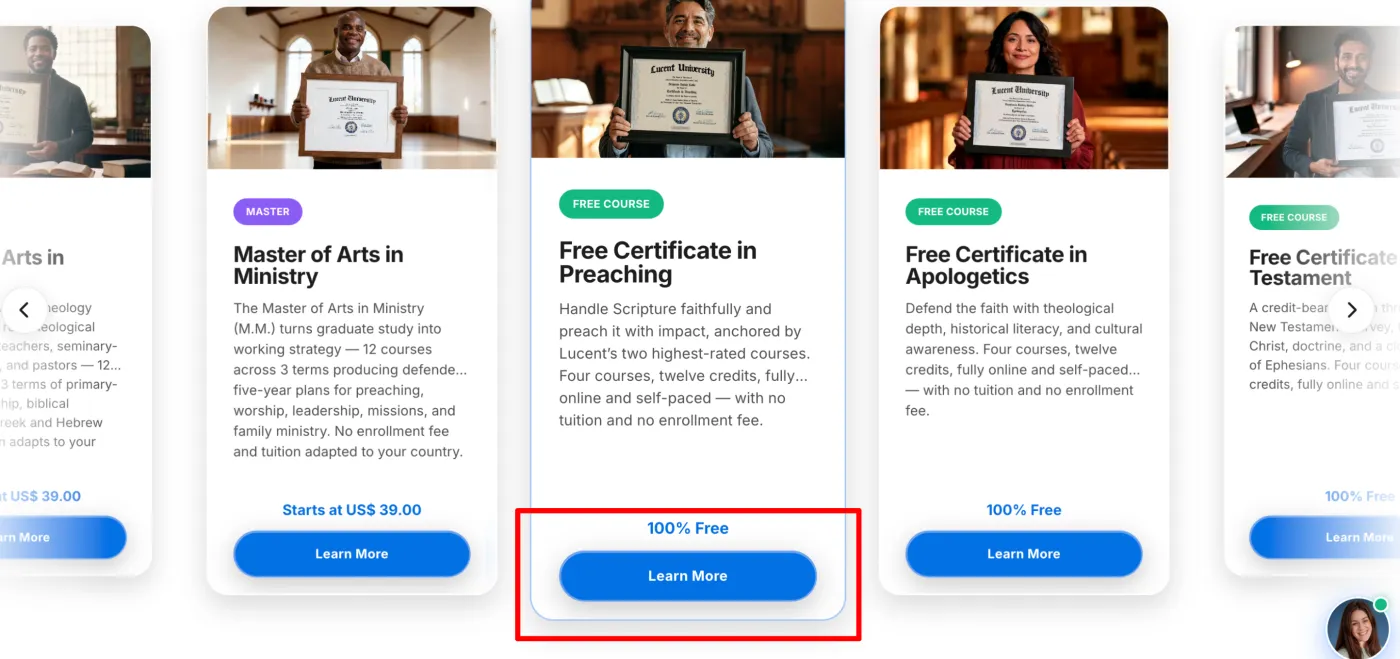
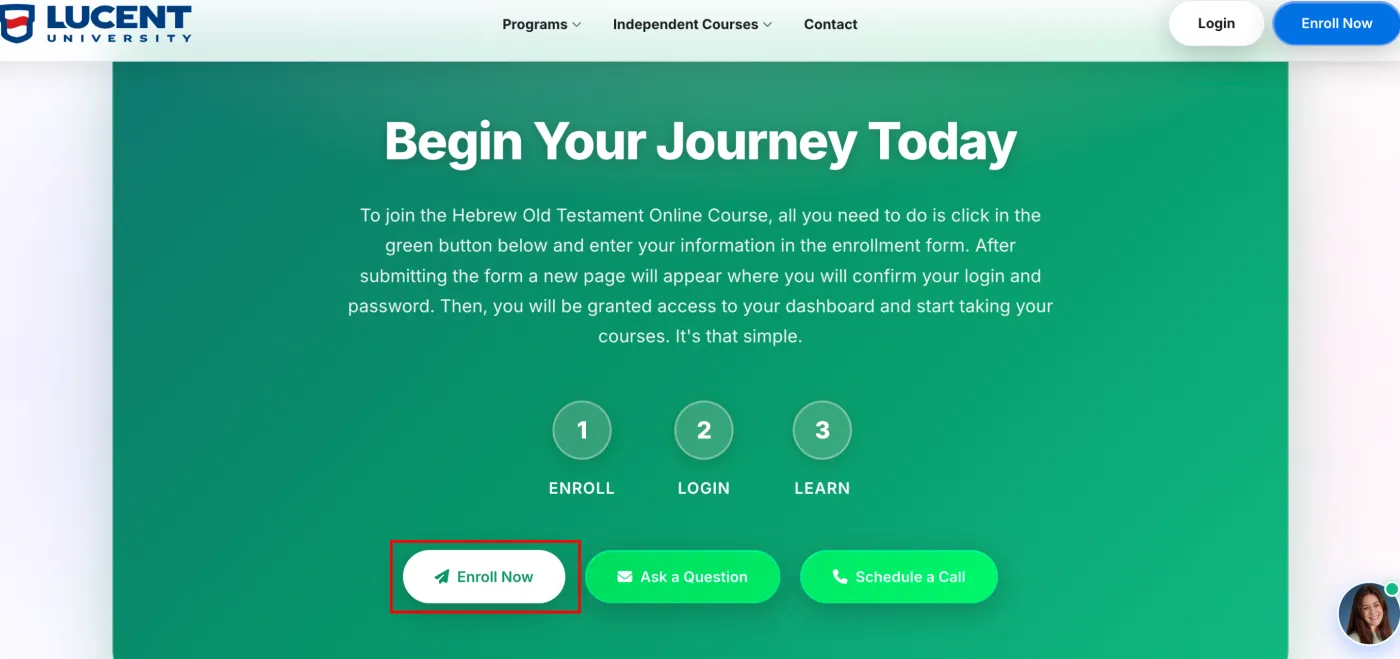
The main page shows an overview of the programs available, along with information about the courses in each program. After choosing a program and selecting Enroll Now on that program's page, the student is redirected to the enrollment page and the process begins.
Figure 1. Main page with the list of programsFigure 2. Deciding to enroll in a program
Enrollment
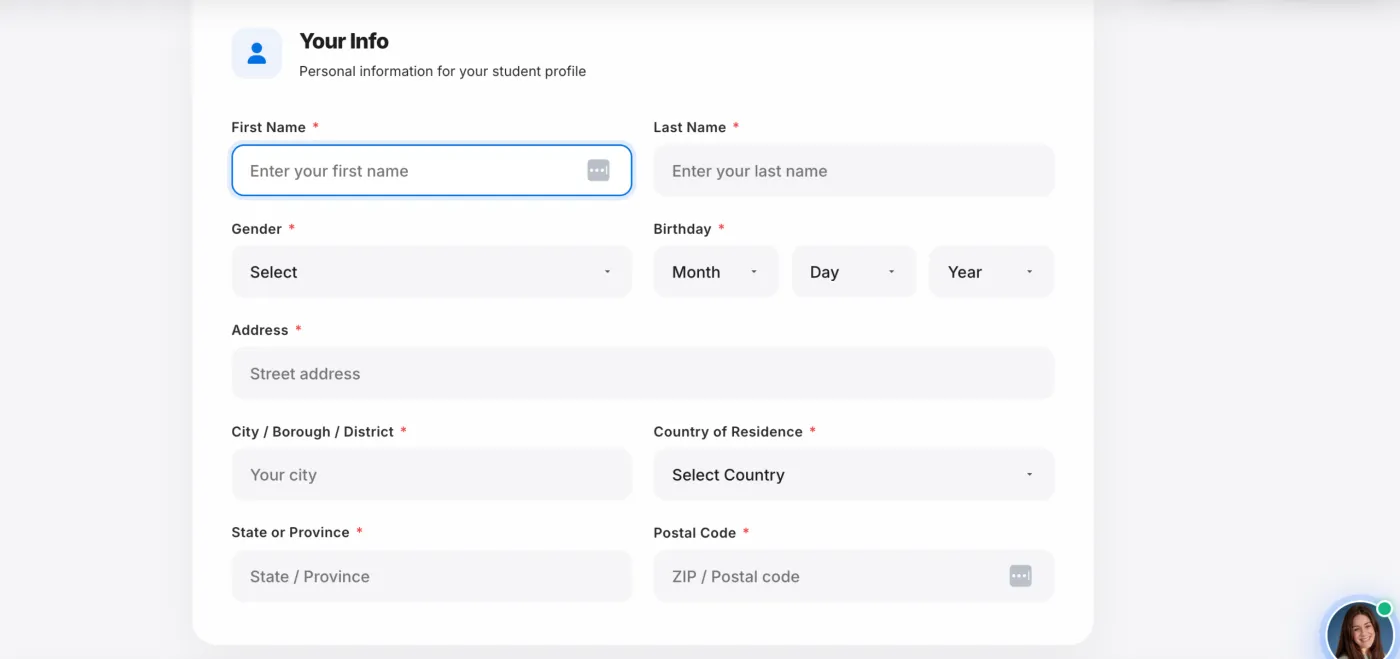
On the enrollment page, the student enters their personal information in the required fields. This information is stored securely by Lucent University, kept indefinitely, and covered by the relevant Data Protection legislation; students can access it at any time through Lucent University administration.
Figure 3. Enrollment page with the required fields
Before submitting the enrollment form, the student must read and agree to the terms available on the Enrollment page.
The student then sees a “Thank you” message and is asked to check the email address they used, where they will find a link and instructions to log in. After clicking the unique link in that email, the student is prompted to create a new password. The system then shows the Terms of Use, which must be accepted before proceeding.
Terms of Use
Before first logging in, the student is asked to review and accept the Terms of Use for the online learning platform. These terms cover account responsibilities, acceptable use, third-party links, content standards, termination, governing law, and how the terms may change over time, and are available in full on the learning platform itself.
Test of English Comprehension (TEC)
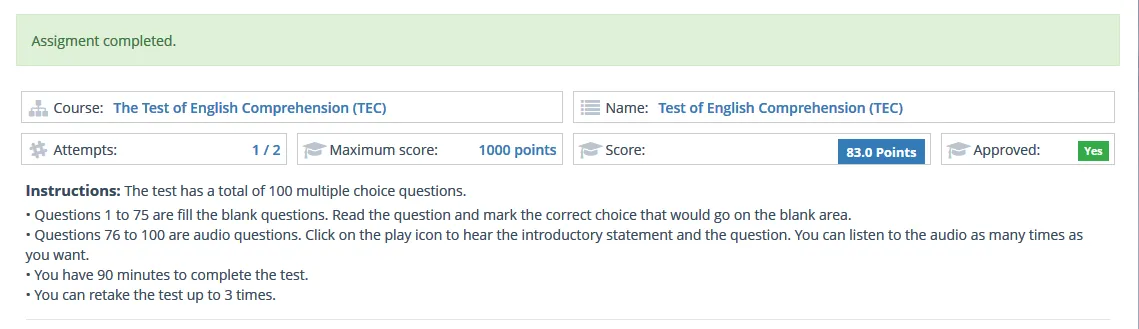
After accepting the terms, the student proceeds to the next step, the Test of English Comprehension (TEC). The TEC is mandatory for all non-native English speakers and cannot be waived, even if you have previously taken English courses or completed a degree taught in English. Because our open enrollment process does not include admission interviews, this assessment is the standard way we ensure you are fully prepared to succeed in an English-only academic environment. The instructions for the TEC are inside the test, as shown below:
Figure 4. TEC instructions with results
After finishing the TEC, the student can continue by clicking Return to Main Page at the bottom of the page.
Payment
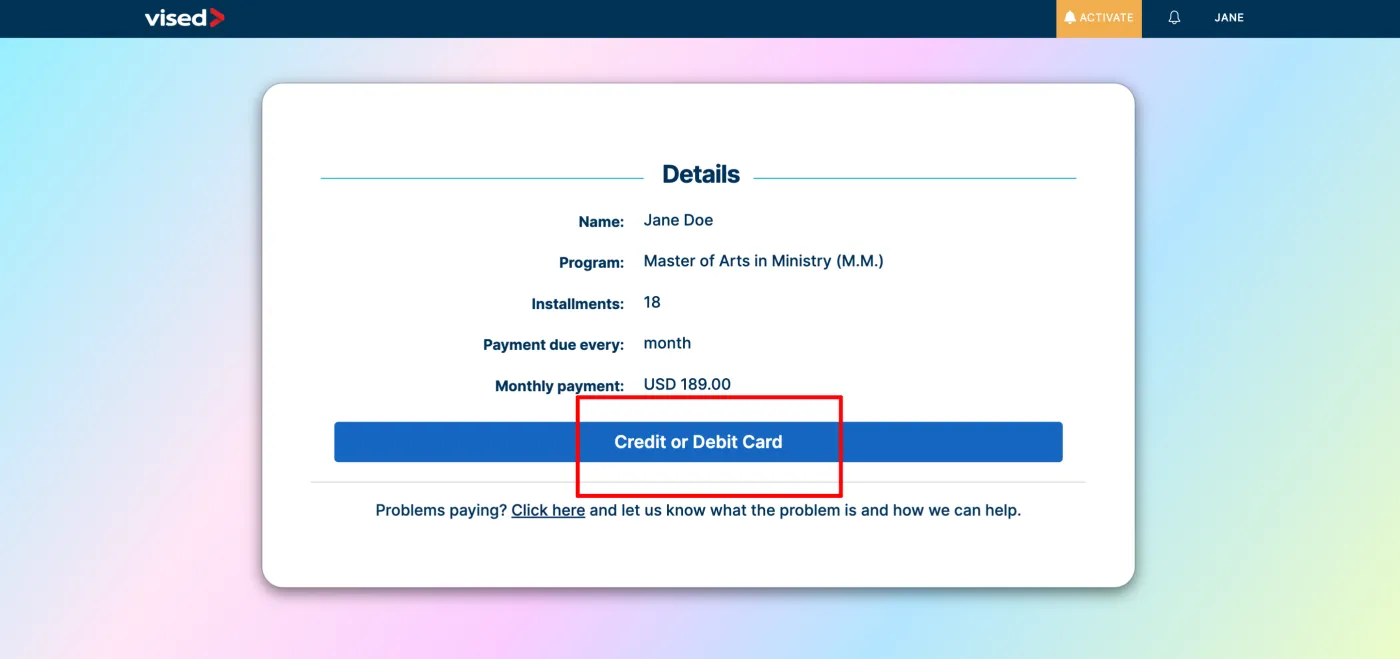
In the next step, the student pays the tuition. The payment details depend on the program chosen and the country entered on the enrollment form. In the example below, the United States was chosen for the Master of Ministry program.
Figure 5. Payment page
The student can pay with any major debit or credit card, processed via Stripe, or with PayPal.
Lucent University uses the World Bank's Purchasing Power Parity (PPP) to set the cost of every program we offer. To check the tuition for a program in each country, go to that program's page and select the country in the “Affordable” section.
If the student receives a scholarship, the President of Lucent authorizes the technical team to bypass the payment page.
Additional Documents
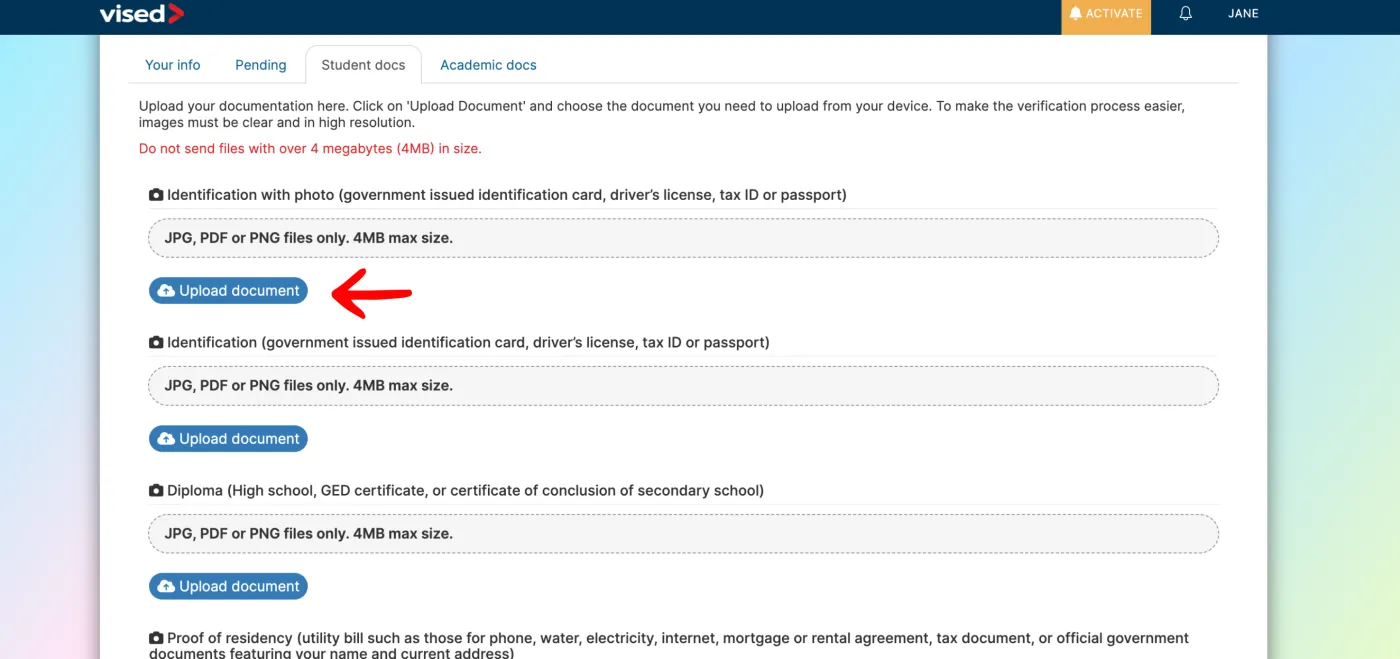
After the first login, the student has 90 days to upload the remaining documents required for the chosen program.
Figure 6. Document upload area for students
Enquiries and Applications
Lucent University keeps digital records for all its students, collected from the data students provide through the application and enrollment processes and through their course and module registrations. This information is covered by the relevant Data Protection legislation, and students have the right to access it at any time through Lucent University administration.
All applications received are divided by course, and the Admissions Officer decides whether to accept or reject each application. All decisions taken by Lucent University are recorded in the Lucent University Management System, as are the applicants' decisions to accept or decline our offer and their responses.
Receiving enquiries
Lucent University's Front Desk, together with the Marketing and Admissions Office, handles all initial course enquiries, whether in writing, by telephone, or by email, and fulfills requests for information and recruitment materials.
The Admissions Office provides a fast, reliable, and professional service to anyone asking about programs of study at Lucent University. It tracks enquiries, logs sources of information, and follows up on initial contact. Enquiries can also be sent to the relevant office, including the Marketing and Admissions Office, to be addressed and processed. When dealing with enquiries about applications, suitable checks are made to verify that the caller is, or is speaking on behalf of, the applicant concerned.
Replies to enquiries
The Admissions Office replies to applicants, answering specific questions wherever possible (normally within two working days), reassures the applicant by email that the enquiry is being handled, and provides a contact name for future reference. The email usually refers the applicant to Lucent University's website. Acknowledging and handling an enquiry may take more or less time depending on its nature and urgency.
The Admissions Office also sends the applicant a prospectus, including a welcome letter and an Application Form, or information directing them to the right application form.
Other sources of enquiries
Lucent University may also receive enquiries from existing students or from someone on behalf of a student, from an Awarding Body, from other regulatory bodies, or from anyone interested in Lucent University. All relevant queries are recorded to ensure proper handling.
Online enquiries are generated when a prospective student completes the initial application form and requests a prospectus from the Lucent University website. The resulting records are captured and stored. Enquiries received by post, telephone, email, and other channels are recorded as well. These records are forwarded to Lucent University's Marketing Office, which reviews them regularly for evaluation and takes action wherever required.
Applications
Processing web-based applications
Most applications reach Lucent University through our website. The Admissions Officer downloads and processes the application files every day, and applications received this way automatically create student records.
Time to process an application
Web-based applications are processed by the Admissions Officer within five working days.
Extended time to process an application
In exceptional cases the processing time may be extended, for example when references are missing, when the applicant is applying for an exemption, or when the applicant has completed part of the program in their home country and Lucent University needs to consult the respective Awarding Body before making an offer of admission. In that case, the Admissions Office writes to the applicant:
explaining the reasons for the delay;
inviting their help in obtaining missing information, as appropriate.
Contacting Awarding Bodies
The Admissions Office may contact overseas Awarding Bodies when there are doubts about the authenticity of overseas certificates.
Conditional offers
The Admissions Officer reviews the application and, after careful consideration of the information in the Application Form and the documents enclosed, sends a Conditional Offer Letter. The letter states that Lucent University is willing to offer the student a place on the course subject to payment of the tuition in full or in installments and/or receipt of all required documents, as specified in the letter.
Once enrollment is fully finalized (documents verified, English test passed, and first tuition paid), the student can request the following from the Admissions Officer or Support Team:
An official Letter of Attestation, confirming active enrollment, student ID number, and estimated completion date.
Other relevant documents they can present to the authorities concerned.
Record of applications
As with enquiries, the data of all applications received and the decisions taken by Lucent University are recorded and regularly monitored. Lucent University ensures that all incoming applications and associated personal data are held securely within the admissions department and are distributed and processed with appropriate security throughout the institution. We take particular care to avoid damage and distress from any loss of personal data, which is more likely when large volumes of applications are received and processed in a short time.
Conclusion
Thank you for preparing for ministry with Lucent
Our university is built on years of dedication and guided by the Holy Spirit to unite technology and faith, offering an exceptional learning experience for those called to serve. At Lucent, we're committed to helping you use your gifts to serve God's Kingdom effectively.
We look forward to seeing what the Lord will do in your life and ministry in the years to come.